Historical Background and Origins
In 1957, Omega launched the Speedmaster CK2915 as part of a trilogy of “professional” tool watches alongside the Seamaster 300 (CK2913) and Railmaster (CK2914). While the Seamaster was aimed at divers and the Railmaster at engineers, the Speedmaster was conceived for motorsport and racing enthusiasts – “a watch for racing drivers”. Its very name Speedmaster followed Omega’s naming trend (after Seamaster and Railmaster) and underscored the watch’s focus on speed measurement. The watch was designed by Claude Baillod under the supervision of Omega’s design chief Pierre Moinat, with prototypes by Georges Hartmann and final execution by Désiré Faivre. Omega’s marketing in 1957 pitched it as a “high-precision wrist computer” for men who “reckon time in seconds,” highlighting that it allowed a driver to measure speed with “no calculating, no paperwork”. This was achieved via a novel Tacho-Productometer scale engraved on its bezel – an innovative first in wristwatch design.
Innovative Design and Technical Features
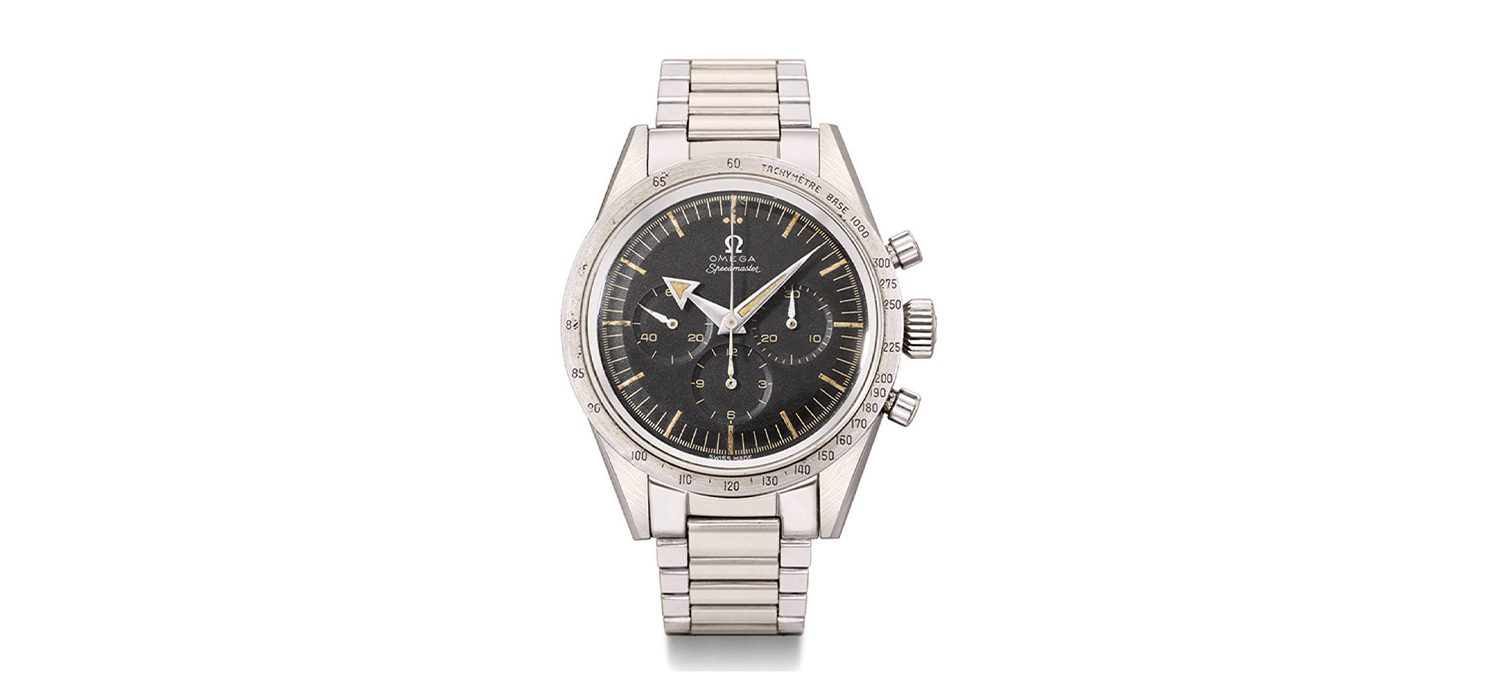
The Omega Speedmaster CK2915-1 “Broad Arrow” (1957) featured a 38–39 mm steel case with straight lugs and the now-famous engraved Base 1000 tachymeter bezel. Broad Arrow hour and dauphine minute hands with ample radium lume maximized legibility.
The CK2915 established the template for all future Speedmasters. It was the first chronograph to move the tachymeter scale off the dial and onto an external bezel, improving dial readability. Omega called this the “Tacho-Productometer” scale – engraved on a brushed steel bezel insert instead of printed on the dial periphery. Calibrated to a “Base 1000” units per hour scale, it allowed wearers not only to time speed (e.g. miles or kilometers per hour) but also compute production rates (units per hour) or other metrics. This functional innovation was soon emulated by other brands (for example, Rolex’s Daytona in 1963 adopted an external tachymeter bezel). The dial design reinforced the automotive theme: a matte black dial with recessed triple registers (3-6-9 layout) evoked sports car dashboards. The clean “step” dial (a slightly domed dial with a stepped outer track) and sharp baton hour markers with radium lume provided excellent legibility. An outer 1/5th second track enabled precise stopwatch reading. Notably, the hour hand was a large “Broad Arrow” design – a wide arrowhead shape filled with lume – paired with a longer pointed dauphine minute hand. This distinctive broad arrow handset was unique to the first generation Speedmaster and would disappear in later references, making the CK2915 immediately recognizable.
The case of the CK2915 was 38–39 mm in diameter (measurements vary slightly, ~38.2 mm reported), notably large for its era, with 19 mm lug width straight lugs that had no crown guards – a clean utilitarian look. Omega ensured it was a true tool watch: the caseback screwed down and used a double-step profile, achieving water resistance rated to 200 feet (≈60 meters) thanks to a triple-seal design. Early models even included a soft iron antimagnetic inner cover over the movement (a nod to the Railmaster’s tech) to protect against magnetism. The case was manufactured by Huguenin Frères (HF), a famed Swiss casemaker – the inner caseback is stamped “HF” along with “Ω OMEGA WATCH CO, FAB. SUISSE, ACIER INOXYDABLE” and the reference number. On the outside, the very first CK2915-1 and -2 had only the word “Speedmaster” engraved diagonally across the smooth caseback bevel, with no Seahorse logo initially. (The Seahorse/Hippocampus emblem, borrowed from the Seamaster line, would appear a couple years later on some late CK2915-3 backs.) The overall build was impressively robust – Omega touted it as “shock-proof, anti-magnetic and water-proof”, a durable instrument for professionals.
In summary, the CK2915’s design was groundbreaking in 1957: a highly legible, purpose-built chronograph with innovations like the external tachymeter bezel and “Broad Arrow” luminous hands. It was a watch created for functionality – “for men who reckon time in seconds” – which laid the foundation for the Speedmaster’s legendary status long before the Moonwatch era.

Caliber 321 – The Beating Heart of the Broad Arrow
Omega’s Caliber 321 movement (Lemania CH27 base) – a 17-jewel, manual wind column-wheel chronograph with 18,000 vph beat rate – was the mechanical heart inside every CK2915.
Powering the CK2915 was Omega’s now-legendary Calibre 321, one of the most revered chronograph movements in watchmaking. This movement began life as the Lemania 27 CHRO C12 in 1942 (Lemania was a sister company in SSIH), developed by Albert Piguet, and it was first adopted by Omega in the mid-1940s. By 1949 it was officially designated Omega Cal.321. The Caliber 321 is a manual-winding, integrated chronograph with a column wheel mechanism and a horizontal (lateral) clutch – a traditional high-grade chronograph design known for precise operation. It operates at 18,000 beats per hour and offers a ~44-hour power reserve. Notably, the 321 was equipped with Incabloc shock protection and anti-magnetic shielding (when housed in the Speedmaster) which helped it pass rigorous tests years later for NASA.
Technically, the Cal. 321’s quality was such that it was also used (in slightly modified form) by some of the most prestigious brands – for example, Patek Philippe’s CH 27-70 and Vacheron Constantin’s cal.1141 were based on the same Lemania 2310 architecture. The movement features a beautifully finished brass/gilt tone with column-wheel control (visible under the caseback, prized by watchmakers for its smooth activation of start/stop/reset). Omega’s version had 17 jewels and was adjusted in multiple positions for accuracy. This durable yet high-precision chronograph caliber is one reason vintage Speedmasters gained such a following – it proved its worth not just on racetracks but eventually in the vacuum of space (the very same Cal 321 would later be worn on the Moon in 1969).
Watchmaker’s note: Early Cal. 321 movements in the CK2915 and subsequent CK2998 have a symmetrical clutch bridge, whereas later service movements introduced an asymmetrical clutch bridge – a detail collectors examine to ensure a given watch’s movement is period-correct. All CK2915s should house a Cal 321 with the symmetrical bridge layout (among other tell-tale traits). Omega’s use of the 321 in the Speedmaster (and its sister Seamaster chronographs) in the 1950s gave these watches a robust engine proven in both civilian and military contexts. The Caliber 321’s legacy is such that it’s revered for its role in the Space Race and has even been reissued by Omega in modern times, attesting to its enduring status among chronograph movements.

CK2915 Variants and Key Details by Reference
Omega produced the CK2915 in three successive iterations: -1, -2, and -3. All share the same fundamental design, movement, and case dimensions, but there are subtle differences of great interest to collectors. In total, only about 3,000–4,000 examples of CK2915 were made across all variants (exact figures are not known), making each variant extremely scarce. Below, we break down the history and exact details of each sub-reference, including production years, serial ranges, dial and bezel variations, and other technical minutiae:
CK2915-1 (1957) and CK2915-2 (1958) – The Original Broad Arrows
The 2915-1 was the very first Speedmaster model, launched in 1957, followed in 1958 by the 2915-2. These two are virtually identical in all observable aspects. Omega seems to have made only minor internal or batch distinctions between -1 and -2, so they are often grouped together. Both feature the original Broad Arrow design and are the quintessential “first Omega in space – on earth” (as they predate any space use but established the lineage). Production of the -1 is believed to be extremely low (perhaps only ~300–500 pieces), while the -2 was likely made in slightly higher number, continuing into late 1958 – yet together the two references probably number well under a couple thousand in total. Known examples of 2915-1 and 2915-2 fall in the ~15.5 million movement serial range (e.g. observed originals around 15,544,xxx and 15,50x,xxx), consistent with Omega’s 1957–58 production. Omega archives for these early watches are sparse – obtaining an Extract can be tricky – but a documented 2915-1 shows production in 1957, delivered to Italy.
Some key details for CK2915-1 and 2915-2:
-
Case & Manufacturer: 38–39 mm steel case made by Huguenin Frères (HF), with straight lugs (19 mm width). The caseback is the double-step style; “Speedmaster” is engraved along the outer bevel (often diagonally). Early -1 and -2 backs may lack the Hippocampus logo entirely (a blank center) – this is correct for many examples. The HF maker’s hallmark and reference number are stamped inside the caseback.
-
Dial: Domed matte black dial with applied metal Omega logo (vintage Omega clover-leaf emblem in steel). The dial printing includes “OMEGA” and “Speedmaster” in white, positioned just below the logo. Notably, the typography has an “Oval O” in OMEGA (the letter ‘O’ is wide and flattened) and the “r” in Speedmaster has a long, curved tail. This font style is characteristic of the earliest Speedmasters. The hour markers are slim faceted indices filled with radium lume (there are no “T” marks, since tritium was not yet used). The three subdials (constant seconds, 30-minute, 12-hour counters) are slightly recessed and notably have shorter index tracks than later dials – collectors call these “short subdial indices.” At the bottom of the dial, SWISS MADE appears (without T), and on many early pieces the printed text sits high on the dial, very close to the applied Omega logo (“high print” dial, though some are “low print” – a minor variation within spec).
-
Hands: The hour hand is the iconic Broad Arrow – a large arrowhead shape filled with lume. The minute hand is a matching style (large triangular dauphine, long enough to reach the minute track). All CK2915s have leaf-style subdial hands, which are small, pointed and either polished steel or occasionally seen painted white – both types appear on surviving examples, and it’s unclear if both were original from factory. The chronograph central seconds hand is a straight pointer in polished steel (unpainted) on the -1 and -2. Fun fact: later references would switch to painted white chrono hands for better legibility, as the shiny steel could be hard to read against the dial – a lesson perhaps learned from the CK2915 and its predecessor the Rodania Geometer.
-
Bezel: Brushed stainless steel bezel with engraved Tachymètre “Base 1000” scale filled in black enamel. The scale is numbered from 300 (at 12 o’clock position) up to 1000 near 1 o’clock, reflecting the Base 1000 calibration. There are a couple of known font variations on these early steel bezels – for instance, some very early bezels have a distinctive flat-top “3” in “300”. Due to a manufacturing quirk, these early bezels often did not fit perfectly and could pop off, so many were lost or replaced; as a result, original CK2915 steel bezels are extremely sought-after today. (Collectors have even paid tens of thousands for an authentic bezel, and numerous replicas exist.)
Overall, a correct CK2915-1 or -2 will look identical to each other. In fact, without peeking inside the caseback to see the stamped reference, it’s essentially impossible to distinguish a -1 from a -2 by external features. Both represent the purest form of the “Broad Arrow” Speedmaster and are the most coveted by collectors due to their rarity and historical significance (the 2915-1 being the first Speedmaster model)

CK2915-3 (1959) – The Transitional Broad Arrow/Alpha Model
The 2915-3, produced only in 1959, was a transitional reference that bridged the first-generation Speedmaster to the next (the CK2998). Omega mixed and matched parts during this period, so the CK2915-3 is known for variations – some examples look just like the earlier Broad Arrows, while others foreshadow the next model with new hands or bezel. This happened because Omega likely used up remaining Broad Arrow-era components while also introducing new elements for the upcoming 2998, resulting in a bit of a grab-bag of specifications in -3 watches. All CK2915-3 carry movement serials in the 16.6 million range (approximately 16,640,xxx observed), fitting production in 1959. Here are the key characteristics and options for the 2915-3:
Hands: Uniquely, the 2915-3 was produced with two possible hand configurations: the classic Broad Arrow set or the new *“Alpha” hands. The Alpha style hour hand is a slim metal dauphine with a longer triangular profile (basically the style used on the succeeding CK2998). On the 2915-3, these alpha hour hands were slightly longer than those on the first batch of 2998s, reaching closer to the dial markers. (If you see a 2915-3 with alpha hands that are too short, they may be later replacements meant for a 2998.) The minute hand would also be an alpha style (long and slender) in that case. Broad Arrow handsets, identical to those on -1/-2, were still used on many 2915-3s – essentially Omega was transitioning, and both styles are considered correct. Important detail: If a 2915-3 has the Alpha hands, evidence suggests it should also have a painted white chronograph seconds hand (matching what came with the early 2998). Broad Arrow-equipped 2915-3s, by contrast, continued with the steel chrono hand. This means an alpha-hand -3 with a steel chrono hand might be an incorrect part swap. Subdial hands on the -3 could be leaf or sometimes small batons; at least one alpha-hand example showed white painted subdial hands (again aligning with the 2998 style), but this detail is less documented.
Bezel: The 2915-3 also came with either of two bezel types: the original steel Base 1000 bezel or the newly introduced black “BASE 1000” bezel. The black bezel was an anodized aluminum (or early acrylic/bakelite) insert with white printed tachymeter scale – visually similar to what would be standard on the 2998 and all later Speedmasters. Many 2915-3 Broad Arrow examples kept the steel bezel, whereas the alpha-hand versions often (though not universally) were paired with the black bezel. There isn’t an absolute rule – watches have been seen in all combinations, and parts could have been swapped in service – but it’s thought that Omega intended alpha-hand models to go with the new black bezel while some Broad Arrow models used remaining steel bezels. Collectors thus evaluate 2915-3s partly by their equipment combination: Broad Arrow + steel bezel is more the “old look,” Alpha + black bezel is the “new look,” and mixed pairs (BA with black, or Alpha with steel) also exist. All black bezels on 2915-3 are the “Base 1000” type (numbered to 1000); interestingly there were two minor font versions of these early black inserts, differing in the shape of the number “4” on the scale (one has an open 4, one a closed top 4), but both types are period-correct.
Dial: The dial on the 2915-3 remained the same base design: matte black, applied logo, radium lume, “Omega” and “Speedmaster” text. By late 1959 some dials might show subtle font differences if they were actually the batch intended for the 2998. For instance, the Oval O persisted, but some say the O became slightly less flattened on the very late dials (edging closer to the 2998’s printing). The presence of “SWISS MADE” without T remained, and the subdial indexes were still the shorter style (the change to longer markers happened with later 2998-4/ -5 dials). One notable update: many CK2915-3 casebacks finally bore the Hippocampus (Seahorse) emblem in the center, with “Speedmaster” engraved above it around the perimeter. Omega basically added the Seahorse logo to the existing caseback design – a clear indicator of a late -3 or service-era caseback. Some 2915-3s still have no Seahorse (likely using leftover earlier backs), while others have it – both can be correct. The engraving of “Speedmaster” also shifted to sit above the seahorse (rather than diagonally across the back).
In essence, the CK2915-3 is a “transitional” Speedmaster that can appear in two guises: one foot in the Broad Arrow era, one foot in the new Alpha-hand era. It’s a favorite among scholars because it illustrates Omega’s practice of part overlap – for example, an Alpha-hand 2915-3 with black bezel is almost indistinguishable from the first CK2998-1 (the main difference being the reference number inside and a slightly longer hour hand on the -3). Conversely, a Broad Arrow 2915-3 with steel bezel looks just like a 2915-1/-2 except for the engraving inside the case. From a collector perspective, the 2915-3 Alpha variant is the rarest configuration, since it was produced for a short time. If one encounters a 2915-3, it is crucial to verify that any Alpha hands, bezel, etc., are authentic to the watch because many have been modified over time. Known genuine 2915-3 examples in top condition are exceedingly scarce; one sold at auction for CHF 81,000 in 2016, reflecting its status as a crossover collectible between the first Speedmaster and the famed CK2998 “first in space”.

The Rodania Geometer Influence: A Predecessor to the Speedmaster?
Multiple examples of the Rodania Geometer (circa 1954–1956), a 38 mm triple-register chronograph whose design closely mirrors the early Speedmaster’s dial layout and case style. The Geometer’s existence a few years prior has led to debate about its influence on Omega’s CK2915.
No detailed history of the Speedmaster CK2915 is complete without mentioning the Rodania Geometer, a watch often cited as the “spiritual twin” or even inspiration for the Broad Arrow Speedmaster. The Rodania Geometer was introduced in 1954 – a full three years before Omega’s Speedmaster debut. It was produced by Rodania, a lesser-known Swiss brand, in very small numbers. The Geometer is a 38 mm steel chronograph (coincidentally the same diameter as the CK2915) powered by a Valjoux 72 movement. What’s striking is that, if you remove the branding, the Rodania’s design is uncannily similar to the early Speedmaster: it has a black dial with three recessed subdials at 3-6-9, a minutes/seconds track at the edge, and a simple, functional look. The hour markers and subdial layouts are stunningly close to the Omega’s, and the Geometer even used large luminous dauphine hands (very much like broad-style hands, though in Rodania’s case both hour and minute were broad dauphines). The family resemblance is undeniable when side by side.
However, there are also key differences. The Rodania Geometer did not feature a tachymeter bezel at all – in fact, it had no outer bezel scale. Any timing scales on the Geometer were likely limited to a simple dial printing (some Geometers came with alternate dial colors or possibly telemeter scales in other versions, though the commonly referenced black dial model keeps a clean look). This means Omega’s CK2915 still holds the crown for being the first to externalize the tachymeter; the Geometer wasn’t competing in that specific innovation. Additionally, the Geometer’s chronograph second hand and subdial hands were polished steel, which in practice made them a bit harder to read against the black dial (there was no high-contrast color). Omega “solved” this in later Speedmasters by painting hands white – a subtle evolution in the name of legibility. The Rodania also had a 20 mm lug width (slightly wider strap size than the Omega’s 19 mm), and inside it ticked the Valjoux 72, a famed column-wheel chronograph movement in its own right. Unusually, Rodania adjusted the Valjoux 72 in three positions – a level of regulation often seen only in higher-end brands – indicating Rodania’s serious intent with this model.
The big question is: did Omega copy or draw inspiration from the Rodania Geometer? It’s a bit of a horological mystery. The Geometer’s supposed 1954 introduction predates the Speedmaster’s development, and given the near-identical size and dial layout, some have suggested Omega’s Speedmaster was not an entirely original design. Perhaps Omega’s designers (or case suppliers) were aware of Rodania’s watch. In the 1950s, it was not uncommon for smaller brands to share case blanks, dial suppliers, or ideas with bigger brands – Swiss watchmaking was (and is) a tight-knit industry, and “borrowing” happened in both directions. It’s also possible both companies were simply responding to the same design trends of the era (the mid-’50s saw a rise in interest for scientific and racing chronographs). Rodania’s records are scant (the company never achieved major fame and was nearly wiped out in the Quartz Crisis), so pinpointing the exact timeline and production numbers of the Geometer is difficult. Enthusiasts like those at Fratello and collectors such as @bazamu (who has owned multiple Geometers) have researched this heavily. They’ve found strong indications that the Geometer is indeed mid-’50s – for instance, its radium lume plots register similar Geiger counter readings to other 1950s watches. Yet, hard proof (like catalogs or ads from 1954) remains elusive, leaving the exact birth year an educated guess (it could be 1954 or slightly later, but certainly before ’57).
What we know for sure is that by the time Omega launched the Speedmaster in 1957, the concept of a 38 mm, triple-register sports chronograph was already “in the air.” The Speedmaster’s execution – with the tachymeter bezel (something the Geometer lacked) and the broad arrow hand – was unique enough to stand on its own merits. But the resemblance between the two watches is so strong that the Rodania Geometer has earned a cult following as “the Speedmaster before the Speedmaster.” In recent years, as collectors discovered this obscure model, Geometer prices have risen and a few have surfaced at auctions. Still, by sheer production, the Geometer is incredibly rare (possibly only a few hundred made; some estimates suggest fewer than 100 may survive in collectors’ hands today).
In conclusion, while Omega has never officially acknowledged any influence, the Rodania Geometer remains an intriguing chapter in the Speedmaster’s origin story. It highlights how even iconic designs can have parallel predecessors. At the very least, the Geometer’s existence underscores how innovative the Omega Speedmaster was in taking a familiar 1950s chronograph form and elevating it with new functional elements (like the bezel) and succeeding in mass appeal where Rodania did not. The Geometer today is frequently referenced in Speedmaster discussions as a fun bit of trivia and a prized collectible in its own right – a watch that might have been the “prototype” Speedy in spirit, if not in name.

Legacy and Collectability of the CK2915
The Omega Speedmaster CK2915 is today regarded as a true grail watch – not just among Speedmasters, but in the entire realm of vintage sport watches. Its legacy is outsized: it laid the foundation for the Moonwatch and the entire Speedmaster line that followed. Without the 2915, Omega would not have had the watch that NASA tested and certified for space; indeed, the subsequent reference (CK2998) went to space on the wrist of Wally Schirra in 1962, and later references became the Apollo program chronographs. But collectors revere the CK2915 not for its space history (it technically has none, as all were produced before NASA’s involvement) – rather, it’s treasured for its pure design, rarity, and “first of its kind” status. With an estimated 3,300–4,200 units ever made, and far fewer surviving in original condition, the CK2915 is one of the most sought-after vintage Omegas. The 2915-1, being the first iteration, is especially valued – it has reached record auction prices and only a few hundred were made. The 2915-2 is only slightly “less rare” and equally important in preserving the Broad Arrow design. The 2915-3, while a transitional reference, is also extremely scarce and interesting for collectors due to its alpha-hand variations.
From a collector’s technical standpoint, the CK2915 presents a challenging but rewarding hunt. Key original parts – notably the steel tachymeter bezel – are almost unobtainium. Many 2915s in the market have had missing or damaged bezels, given how easily those early bezels popped off or got swapped; a correct bezel can be the difference between a six-figure watch and a frankenwatch. As noted, numerous replica bezels exist (some so well made that even top auction houses exercise caution, sometimes preferring to sell a 2915 without any bezel rather than risk a counterfeit bezel). Dials too can be subject to restoration – the radium lume often aged to a dark patina or even flaked off. A genuine, untouched CK2915 dial will typically show creamy lume, an applied logo, and that distinctive oval “O” font. Movements should be checked for the correct Cal 321 components (as discussed, the clutch bridge style, and ideally a serial in the known range with an Omega Archive extract to verify origin if possible). Original crowns and pushers are another detail: the CK2915 came with a 7 mm diameter clover crown and slim pushers (~4 mm); many were later serviced with different crowns/pushers, so finding ones with the correct original hardware is a plus.
Despite its relative obscurity for decades (collectors long focused more on later “Moon” Speedmasters), the CK2915 now enjoys almost mythical status. It is, after all, the first Speedmaster – the reference that started a lineage of chronographs that would go from timing race cars to timing EVA spacewalks. Its design elements like the Broad Arrow hand have been reissued in modern homage editions (for example, Omega’s 1997 Replica and the 2007 50th anniversary Broad Arrow, as well as the more recent 2017 Trilogy series), but connoisseurs will always prize the original 1957–59 pieces for their authenticity. When handling or beholding a CK2915, one can appreciate the cutting-edge 20th-century tool watch aesthetics it introduced – a watch born for motorsport, yet versatile and robust enough that it inadvertently became fit for space. In the pantheon of collectible watches, the CK2915 stands tall as one of the most important chronographs ever made. Its blend of technical innovation, design purity, and scarcity make it a crown jewel for those lucky enough to own one, and a subject of endless fascination for the rest of us who admire it from afar.
Sources: Omega archival and collector literature, Moonwatch Only (Omega), Fratello Watches, Speedmaster101, Revolution Watch, Analog/Shift, Hodinkee, WahaWatches, Corrado Mattarelli, and Bazamu/Fratello (Rodania Geometer).

