Introduction and Origins
The IWC Ingenieur SL Ref. 1832 – often nicknamed the “Jumbo” – is a legendary 1970s sports watch that remained under the radar for decades. Launched in 1976, the Jumbo Ingenieur was IWC’s answer to the emerging luxury steel sports watch trend led by Gérald Genta’s Audemars Piguet Royal Oak (1972) and Patek Philippe Nautilus (1976). In fact, the ref. 1832 was designed by Genta himself for IWC, making it the third of his 1970s “integrated steel trilogy”. Yet unlike its famous siblings, the Ingenieur SL struggled commercially in its time – only a few hundred were made – but has since become a cult classic appreciated for its technical innovation and rarity.

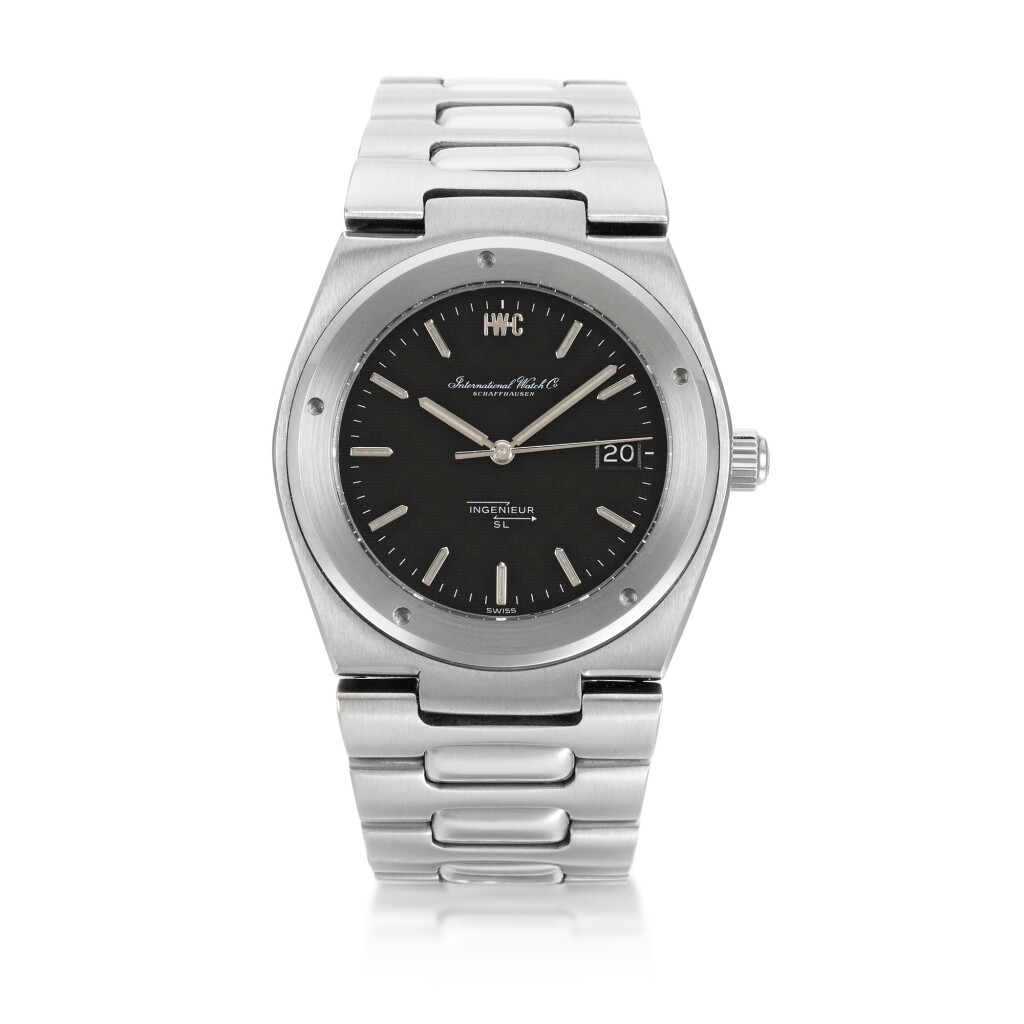
The IWC Ingenieur SL “Jumbo” Ref. 1832 in stainless steel, shown on the wrist. This Genta-designed watch features a bold integrated bracelet and a round, screw-fastened bezel with five recesses. Its black dial carries a distinctive basket-weave or “graph paper” guilloché texture – a signature of the Ingenieur SL – along with luminous baton hands and markers. The dial text at 6 o’clock includes the lightning-bolt Ingenieur logo and “SL” designation, underscoring the watch’s technical, tool-watch character.
Origins of the IWC Ingenieur SL Ref. 1832
The Ingenieur model actually dates back to 1955, when IWC introduced it as one of the first anti-magnetic wristwatches (Ref. 666) for engineers and scientists. By the 1970s, however, the Ingenieur line was due for a modern overhaul. The Quartz Crisis was in full swing, and luxury brands were exploring bold new designs in steel. In 1974, IWC commissioned famed freelancer Gérald Genta – the man behind the Royal Oak and Nautilus – to reinvent the Ingenieur for a new era. The mandate was to create a high-end sports watch in steel with an integrated bracelet, while preserving the Ingenieur’s core identity of ruggedness and anti-magnetic protection.
Genta’s design was completed by 1974 and refined in-house at IWC by design engineer Hanno Burtscher. The result, released in 1976, was the Ingenieur SL (“SL” officially stood for Steel Line, though IWC later implied Sports Line) as reference 1832. It debuted alongside a couple of other SL collection models (the IWC Polo Club ref. 1831 and Golf Club ref. 1830), but the Ingenieur was the flagship. True to Genta’s style, the new Ingenieur looked radically different from earlier IWC watches – a contemporary luxury sports watch with integrated case and bracelet architecture. Internally, IWC equipped it with their best automatic movement and a soft-iron inner cage, ensuring it met the Ingenieur standards of magnetic resistance.
Despite its impressive pedigree and engineering, the Ref. 1832 “Jumbo” was not an immediate success. The watch-buying public in the late 1970s found it too large, heavy, and costly for the tastes of the time. In 1976–77, sales of mechanical watches were extremely slow, and the Ingenieur SL’s chunky 40 mm design was the opposite of the slim, quartz-powered fashion. Its retail price was around 3,850 DM (~$2,370 in 1979), which was over three times the price of a Rolex Milgauss 1019 ($725 in 1979). As a result, production remained very limited – IWC stopped the Jumbo’s run after roughly 7 years, in 1983. In total fewer than 1,000 pieces of the first-generation Ingenieur SL (all variations) were produced. By one count, about 543 were in stainless steel with the automatic movement and 55 in solid 18k gold. (Quartz-powered versions accounted for a few hundred more – discussed later.) This extreme rarity, combined with its Genta design DNA, has made the ref. 1832 highly sought-after by modern collectors, even though it was a “flop” in its own day.
Design and Technical Features of the “Jumbo” 1832
The IWC Ingenieur SL ref. 1832 embodies many hallmark features of Genta’s 1970s designs, yet it also has distinct engineering touches befitting the Ingenieur name. The watch’s case is a substantial, cushion-shaped form measuring about 40 mm in diameter (38 mm across the bezel) by 12.5 mm thick. Unlike earlier round Ingenieurs, the SL has a wide, tonneau/cushion body with a circular bezel secured by five visible screw recesses. These five recesses (sometimes called “rivets”) are not aligned symmetrically; because the bezel screws down, the recesses end up at random positions on each watch – an intentional quirk to give each piece a unique look. The bezel and caseback are both screwed onto the mid-case (a tri-part construction), ensuring robust water-tightness. Indeed, the Jumbo Ingenieur was rated 120 m water-resistant (about 12 ATM) in steel models – a very high spec at the time, and double the depth rating of the earlier 1960s Ingenieurs in steel. (The gold versions, however, were rated to 60 m given softer metal). The watch also carried a thick sapphire crystal and a screw-down crown to aid durability.

The dial of the ref. 1832 is another standout element. Early examples were offered in black, silver-plated (rhodium tone), or gilded finishes. Many featured a unique guilloché pattern often described as “graph paper” or “basket-weave,” consisting of tiny intersecting lines across the dial surface. This textured motif reinforced the Ingenieur’s scientific aura – a nod to engineering graph paper – and set it apart from the plain dials of its competitors. The applied markers are simple baton indices, paired with slender pencil-style hands filled with luminescent material (tritium on original dials, marked “T SWISS T” at dial bottom). Notably, at 12 o’clock the IWC logo (stylized “International Watch Co.” script with IWC monogram) is applied, and at 6 o’clock the dial displays the model’s identity: the word Ingenieur above “SL” (for Steel Line), often alongside the Ingenieur’s lightning-bolt emblem – a symbol of electrical resistance. A date window sits at 3 o’clock, maintaining symmetry with a beveled frame. All together, the watch projects a “technical yet luxurious” aesthetic – blending tool-watch substance with 1970s style.
Perhaps most important is what you don’t see: the Ingenieur’s anti-magnetic architecture. Like its 1950s predecessors, the Jumbo SL has a soft-iron inner case (a Faraday cage) enveloping the movement and even a soft-iron dial backing, which together give it a magnetic resistance up to 80,000 A/m (approximately 1,000 Gauss). This was a top-tier spec for the era (comparable to Rolex’s Milgauss). IWC proudly noted that the Ingenieur SL could “withstand 1000 Gauss” – true to the watch’s name and legacy. The trade-off was the case had to be thick and heavy: a steel Jumbo on bracelet weighs around 155 grams, significantly heftier than a Royal Oak or Nautilus of the time. This gave the Ingenieur SL a reputation for being over-engineered and “built like a tank” – in the words of one reviewer, a “chunk of Teutonic steel” on the wrist. Indeed, the watch’s Germanic, utilitarian vibe stood out against the more elegant French-swiss styling of its Genta siblings.
Inside, the ref. 1832 was powered by a superb IWC in-house movement, the caliber 8541ES. This automatic caliber was a modified version of IWC’s 85xx Pellaton series, widely considered one of the best post-war automatic movements. The base 8541 had 21 jewels (up to 25 with date), beat at 19,800 vph, and featured the famous Pellaton pawl-winding system for bi-directional winding efficiency. The special “ES” suffix on the 8541ES denotes upgrades for the Ingenieur: E for éomagnetic ( amagnetic ) components and S for seconde arrêt (stop-seconds). IWC incorporated amagnetic alloys in the hairspring and certain escapement parts (e.g. the mainspring and lever) to improve magnetic resistance. They also added a hacking seconds function (allowing precise time-setting), which earlier 85xx calibers lacked. Furthermore, the movement in the Jumbo was cushioned on rubber mounts inside the case – tiny rubber ring absorbers that protect against shock. This was a carryover idea from the IWC Yacht Club model; combined with the Ingenieur’s thick case and screw-secured bezel, it made the watch exceptionally robust against both impact and magnetism. Unlike the ultra-thin movements used in AP and Patek’s luxury sports watches (which omitted a seconds hand for slimness), the IWC 8541ES was relatively thick but included a full central seconds mechanism. In practice, the Jumbo Ingenieur was thicker and less sleek than its rivals, but technically it was more of a “real” tool watch – boasting high durability across water resistance, magnetism, and shock.
In summary, the ref. 1832 “Jumbo” Ingenieur SL was a marvel of 1970s watch engineering wrapped in a distinctive Genta design. Key specifications included:
38–40 mm steel case, 12.5 mm thick, with integrated H-link bracelet (or integrated leather strap on some versions). Water resistant to 120 m (steel). The case and bracelet finishing featured satin-brushed surfaces with polished bevels, exemplifying high quality Swiss case workmanship (IWC likely partnered with specialized case/bracelet makers; forum research indicates the integrated bracelets were supplied by Gay Frères, the famed bracelet manufacturer, as evidenced by hallmarks on some clasps).
Anti-magnetic construction: soft-iron inner case and dial shield providing resistance to 80,000 A/m (about 1,000 Gauss). This was double the resistance of later “Skinny” Ingenieur models, which dropped to 40,000 A/m due to their thinner design.
Dial and hands: Available in black graph-paper guilloché, silver (“rhodium-plated”) or gold-toned, all with luminous baton markers and hands. Date at 3:00. Early originals have “T SWISS T” on the dial; later service dials might show “SWISS” only. The iconic lightning-bolt Ingenieur logo is printed above 6, along with “SL” (and “Quartz” on the quartz models).
Movement: IWC cal. 8541ES automatic; 21 jewels, Pellaton winding, 19,800 vph, with date and hack-seconds. Amagnetic alloy components and shock dampers were employed for durability. This was the only Ingenieur SL generation to use a fully in-house IWC movement – later versions would use modified ETA or JLC ebauches.

Because of the high production quality and complexity, IWC produced the ref. 1832 in very limited numbers. The serial numbers (case and movement) for these watches fall in the low 2 million range, consistent with mid-1970s IWC production. For example, a verified Ref. 1832 from circa 1978 carried movement no. 2,178,241 and case no. 2,203,160. Early 1976 pieces appear to have slightly higher serials (around 2.22x million) due to IWC’s numbering quirks, but only a few hundred movements were ultimately used for this model. All told, approximately 598 Jumbo Automatics were made (543 in steel and 55 in gold). These numbers are tiny – by comparison, Audemars Piguet made about 5,000 of the original Royal Oak “Jumbo” Ref. 5402, and Patek made a similar amount of Nautilus 3700 in that era. It’s no wonder the IWC 1832 is roughly ten times rarer than its peers on the vintage market.
Production and Collectability
IWC’s production records indicate that the Ingenieur SL “Jumbo” was manufactured from 1976 until 1983/84, when remaining stock was sold off. Within that span, total output (including all metal variants and quartz versions) was under 1,000 units. An internal figure often quoted is 978 pieces in total (approximately 598 automatic and 380 quartz) produced between 1976 and 1984. Such low production was primarily due to poor sales – the watch was “launched at the wrong time,” as collectors note. By the late 1970s, large steel luxury watches were a tough sell, and the Ingenieur SL in particular was considered too bulky and expensive by many customers. IWC even had to convert some unsold quartz models into automatics (and vice versa) to meet the pockets of specific customers, which shows how they struggled to move inventory.
After discontinuation in 1983, the Jumbo Ingenieur remained a relatively obscure model for a decade. Only seasoned IWC enthusiasts knew of its significance, and second-hand prices stayed modest through the 1990s. However, the turn of the 21st century brought a renaissance for Genta’s designs. As the Royal Oak and Nautilus became blue-chip collector pieces, attention eventually turned to the “third sibling” from Schaffhausen. Around the mid-2000s and especially the 2010s, the ref. 1832 started gaining value and recognition. IWC collectors realized that “the 1832 ‘Jumbo’ would become a sought-after model, greatly increasing in value” in the decades after its demise. By the 2020s, the Jumbo Ingenieur SL is firmly established as a cult classic.
Today, the watch’s collectability rests on several factors:
Rarity: With only ~600 automatic pieces ever made (and just ~543 in steel), the ref. 1832 is far scarcer than a vintage Royal Oak or Nautilus. In fact, summing all five generations of Ingenieur SL automatics from 1976–2001, an estimated fewer than 5,000–6,000 pieces were produced in total. This makes the entire Genta-era Ingenieur series exceptionally rare. The ref. 1832, as the first and rarest iteration, has the cachet of being one of the most elusive 1970s sports watches.
Technical Interest: Collectors admire that the Jumbo Ingenieur truly lived up to its name – it wasn’t just a Genta design slapped on any movement. It had IWC’s last great in-house caliber of the era (8541ES), a 1,000 Gauss anti-magnetic rating, and tank-like build quality. It was arguably the purest “tool-watch” of Genta’s trilogy, with engineering chops that the Royal Oak and Nautilus (which used ultra-thin outsourced movements and were not anti-magnetic) didn’t match. This uniqueness has become a selling point as enthusiasts dig into the history.
Design pedigree: The involvement of Gérald Genta is, of course, a huge draw. The Ingenieur SL has all the 1970s Genta hallmarks – integrated bracelet, bold geometric shapes, a mix of polished and brushed surfaces, etc. – yet it also stands out for its “industrial” aesthetic (sometimes described as more Teutonic or muscular in design). In hindsight, many appreciate it as a charming outlier among luxury sports watches. Even IWC itself has recently acknowledged this legacy, producing new models inspired by the 1976 original design.
Rising profile: For years the 1832 was undervalued, but the market has been catching up. As one journalist quipped, “if only Brad Pitt hadn’t worn one, it would’ve remained one of the greatest under-the-radar refs” – implying that celebrity attention has further increased its visibility. In the last few years, auction results and dealer prices for the Jumbo have jumped accordingly. In 2020, a steel Ingenieur SL with papers was estimated around CHF 8,000–12,000 (then roughly $8–13k). By 2023–2024, examples in excellent condition were appearing with asking prices in the high five figures; one dealer listed a full-set 1832 at $26,900. The trajectory suggests that as collectors continue to discover the Ingenieur’s story, demand will stay strong.
All of these factors make the IWC 1832 a fascinating study in collectability – a watch that went from “forgotten failure” to “holy grail” over 40+ years. As IWC’s Museum Curator David Seyffer said, this model has finally assumed its “rightful place” among Genta’s historic works. Seasoned collectors now actively hunt for fine examples of the Jumbo, especially ones with original tritium dials (many were later serviced with “SWISS”-only replacement dials, so finding a T SWISS T dial is a plus). Gold models (ref. 9232) are ultra-rare at only 55 made, and have their own appeal, though the steel version is generally most coveted for its tool-watch vibe. Given the limited supply, any intact ref. 1832 with its bracelet, correct dial, and papers is a treasure on the vintage market.
Evolution of the Ingenieur SL: Generations and Calibers (1976–2001)
While the ref. 1832 was the original vintage model in the Ingenieur SL series, IWC did not stop there. The company continued the Ingenieur SL line in several generations, all following the design template Genta established but varying in size, movements, and technology. In total, there were five generations of Genta-style Ingenieur SL produced from 1976 to 2001. Below, we outline each generation in exact detail, including the calibers used, approximate production numbers, and notable features:

2. Second Generation “Skinny” (1983–1986) – Mid-Size 34 mm Automatics & Quartz
By the early 1980s, IWC decided to significantly downsize the Ingenieur SL. In 1981, they launched a new mid-sized quartz Ingenieur SL, followed in 1983 by an automatic version in the smaller size. Collectors dub these the “Skinny Ingenieurs” because the case diameter shrank to about 34 mm (from 40 mm) and thickness to only 8.5–8.8 mm – dramatically more svelte than the Jumbo. The weight dropped to around 105 g in steel. The trade-off was a reduction in magnetic protection: these smaller models had 40,000 A/m resistance (approx 500 Gauss), half that of the Jumbo, due to a thinner (or partially omitted) inner iron cage. Water resistance remained a solid 120 m for steel versions.
The Second Gen Automatic was introduced in 1983 as ref. 3505 (steel on integrated bracelet) and ref. 3515 (steel on leather strap), as well as ref. 9225 in 18k yellow gold. Inside was the new IWC caliber 375, which was actually based on the high-grade ETA 2892 ebauche. IWC modified and finished this 21-jewel, 28,800 vph movement, but it was not in-house. The cal. 375 maintained a date function but, unlike the Jumbo, did not have the soft iron movement shroud – hence the lower Gauss rating. The dial design on second-gen automatics stayed very similar to the Jumbo (including the graph-paper texture on many pieces), though slight differences in hands and markers can be found. The case retained the Genta aesthetic but scaled down to 34 mm; notably the integrated bracelet design was also modified to suit the smaller size, with a new “SL Type II” bracelet that had raised central links (it was a bit more flexible than the Jumbo’s stiff flat-link bracelet).
The Second Gen Quartz models actually predated the autos: Starting in 1981, IWC released ref. 3305 (34 mm steel on bracelet) and ref. 3315 (steel on strap) as quartz Ingenieur SL “Midsize” versions. These used the ETA 2250 quartz caliber (the same used in the later Jumbo ref. 3303, thus also 32,768 Hz frequency). Gold versions existed too (ref. 9703 in 18k). In general, these early-80s quartz models looked identical to the automatic skinny Ingenieurs; only a small “Quartz” inscription on the dial (above the 6 o’clock SL logo) gave them away.
Production numbers for the second generation are not well documented, but they were likely also relatively low – probably a few hundred of each reference. Research suggests the total output of all second-gen variants (auto + quartz) was still below the third-gen’s count (the third-gen is estimated at ~800 pieces; see below), so the 1983–86 models are by no means common. Collectors often encounter the “Skinny” Ingenieur and note its excellent wearability compared to the Jumbo, albeit without the in-house movement allure. These second-gen watches continued until about 1985–1987 when the next evolution arrived.
(Key models in Gen 2: 3505/3515 autos and 3305/3315 quartz in steel; 9225 and 9703 in gold.)
3. Third Generation “Skinny 2.0” (1985–1989) – Ref. 3506 Series
Around 1985, IWC made further refinements to the 34 mm Ingenieur SL lineup. The so-called third generation essentially built on the second-gen “Skinny” concept with slight improvements in movements and design details. The new automatic references were 3506 (steel, on bracelet), 3516 (steel, strap), and 9230 (gold). These continued to use an ETA 2892-A2 base, referred to in IWC documentation as caliber 3753x (likely an updated cal. 375). It’s possible IWC made incremental upgrades to accuracy or finishing; for instance, some sources note the addition of a Glucydur balance or other tweaks. Externally, the third-gen looks very similar to the second-gen – a 34 mm case with five bezel screws, etc. There were some new dial variations introduced, including different colors (some examples in white, grey, etc., often with the signature cross-hatch pattern). IWC also expanded the use of two-tone steel and gold combinations in this era.
One notable addition was the use of titanium for a few references (IWC was experimenting with titanium cases in the mid-80s, e.g. the Porsche Design collaborations). However, in the Ingenieur SL context, full titanium models would appear slightly later (see Gen 4 quartz below). The core 3506 series were steel or bi-metal. Production for the third-gen automatics is estimated at only ~800 pieces total – an aggregate number that likely includes all material variants. This estimate comes from IWC forum research and highlights that even as the 80s progressed, Ingenieur SL autos were produced in tiny quantities (for comparison, Rolex would make tens of thousands of watches annually). The late 80s were still a challenging time for luxury mechanical watches, so IWC kept volumes low.
On the quartz side, IWC continued to offer quartz Ingenieurs in 34 mm through this period. References like 3305 remained in the catalog until 1987. Additionally, around 1985, IWC introduced titanium cased quartz Ingenieurs (ref. 3350/3360 for men, and smaller ladies’ versions ref. 4550, etc.). These had 32 mm cases with 120 m water resistance and ~20,000 A/m resistance. While technically part of the broader SL family, these titanium models are sometimes considered a side-line, as they were quartz-only and aimed to showcase IWC’s use of new material (titanium) combined with high tech (quartz). They did, however, carry on the design language of the SL, complete with integrated bracelets (in titanium) and the 5 recess bezel.
By 1989, IWC was ready to push the Ingenieur’s technical limits to new heights, which led to the next generation.
(Key models in Gen 3: 3506/3516 autos in steel/two-tone, 9230 gold; continuing 3305 quartz, plus new titanium quartz variants.)
4. Fourth Generation “500,000 A/m” (1989–1992) – Ref. 3508 “High-Tech Ingy”
The fourth generation of the Ingenieur SL is perhaps the most technologically impressive. In 1989, IWC introduced the Ingenieur Ref. 3508, known as the “Ingenieur 500,000 A/m” model. As the name suggests, this was engineered to withstand magnetic fields up to an unprecedented 500,000 A/m (approximately 6250 Gauss) – far beyond any consumer mechanical watch of the time. In fact, IWC tests showed the watch could keep running accurately even at 3.7 million A/m (≈4.65 Tesla) before succumbing! This was a showcase of IWC’s anti-magnetic expertise. To achieve such resistance, IWC took a standard ETA 2892-A2 movement and heavily modified it. The movement (labeled caliber 37590 by IWC) was outfitted with a special niobium-zirconium alloy hairspring – an extremely costly material that is essentially non-magnetic. This predates similar technologies like Rolex’s Parachrom (niobium alloy) by over a decade. The movement also featured a 21k gold rotor and was placed within an improved soft-iron cage. The case remained 34 mm, but slightly thicker (~10 mm) to accommodate these measures. IWC was so proud of this achievement that they engraved “500,000 A/m” on the case flank of the ref. 3508 models – a bold visual statement of its capability.
The 3508 “500k A/m” Ingenieur was offered in stainless steel, as well as bi-metal configurations, between 1989 and 1992. There was also a variant ref. 3518 (on strap) and a limited number of precious metal versions (some in 18k yellow gold – ref. 9238 – and even a tiny handful with diamonds – ref. 9258). Production numbers were still low but higher than previous generations due to renewed interest. In total about 1,415 pieces of the fourth generation were made across all versions. Of those, roughly 955 were the steel or steel/titanium variants of ref. 3508/3518 (614 pure steel, 341 two-tone), and the rest were gold or strap variants. These figures indicate the 500,000 A/m model was the most “mass-produced” Ingenieur SL up to that point – likely because it garnered attention for its technical merit (and perhaps because by 1990, mechanical watches were making a comeback).
It’s worth noting that the 500k A/m Ingenieur was extremely expensive for IWC to make – the exotic hairspring alloy was notoriously difficult and costly to produce. This may have actually caused financial strain; indeed, IWC’s next move was to pivot slightly away from such expensive innovation toward a more commercially minded approach (as seen in Gen 5). But as a piece of watch engineering history, the ref. 3508 stands tall. Vintage collectors admire these for being far ahead of their time – a true magnum opus of anti-magnetic design. Few watches, even today, boast such magnetic tolerance (for context, even Rolex’s modern Milgauss is “only” 1000 Gauss). The 3508 was arguably the apex of the Ingenieur concept.
(Key models in Gen 4: 3508 steel 500k A/m on bracelet; 3518 steel 500k on strap; some gold variants like 9238. Caliber 37590, modified ETA with niobium spring.)
5. Fifth Generation “Officially Certified Chronometer” (1993–2001) – Ref. 352x Series
By the early 1990s, IWC had proven its technical prowess but now needed the Ingenieur line to be financially viable. Thus, in 1993, they introduced the Ref. 3521, marking the fifth and final generation of the classic SL design. The strategy here was to position the Ingenieur as a high-precision, ultra-professional timepiece with chronometer certification – a smart marketing move to attract enthusiasts as mechanical watches resurged. The dial of the 3521 is marked “Officially Certified Chronometer” at 6 o’clock, a first for the Ingenieur. To achieve this, IWC decided to use a top-grade ébauche from Jaeger-LeCoultre, the JLC caliber 889/2 (known in IWC tuning as caliber 887). This 36-jewel movement was thin (3.25 mm) yet high quality, used in many fine watches of the era (including certain AP Royal Oaks). IWC outfitted it with a platinum rotor – an unusual choice, but platinum is non-magnetic and very heavy (good for winding efficiency). With the JLC 889 inside, the ref. 3521 “Ingenieur Chronometer” was both accurate (COSC-certified) and quite slim. The case remained ~34 mm. Importantly, IWC brought back the original Ingenieur’s full specifications: the ref. 3521 returned to 120 m water resistance and 80,000 A/m magnetic resistance, matching the old Jumbo in technical specs. Essentially, after some cost-cutting in late 80s models, IWC decided to “go all out” again: the fifth-gen had all the bells and whistles – antimagnetic cage, high WR, COSC rating – but built around a reliable JLC movement rather than a bespoke IWC caliber.
The 3521 (steel, on bracelet) and its siblings (ref. 3522 steel on strap; 9239 gold on bracelet; 9259 gold with diamonds, etc.) carried the Ingenieur SL line through the 1990s. They featured some new dial colors (white, grey, black, some with a loupe magnifier on the date window). The design stayed true to Genta’s template, aside from minor tweaks (for instance, some dials moved the “Ingenieur SL” text position, and the bracelets were slightly refined). This generation was well-regarded but faced stiff competition in the booming luxury watch market of the 90s. Eventually, in 2001, IWC decided to end the Ingenieur SL line – the collection was officially discontinued by 2002. IWC would later revive the Ingenieur name with entirely new designs (e.g. the 2005 Gerald Genta Limited Edition, and the modern 2013–2017 line, and even a 2023 homage), but the era of the original 1970s Genta case was over.
The fifth-gen models weren’t produced in large numbers either, though likely more so than earlier gens. Still, total output remained limited. When adding up all variants from 1993–2001, plus the previous generations, the grand total of vintage Ingenieur SL automatics is under ~6000 pieces. This underscores the collectability: even the “mass-produced” chronometer models were relatively scarce.
(Key models in Gen 5: 3521 steel chronometer (COSC), 3522 steel strap, 4521 midsize ladies, 9239 gold, etc., all using JLC 889/Cal.887. Often collectively called the “Ingenieur 3521 series” by collectors.)
Conclusion
Spanning 25 years, the IWC Ingenieur SL series (1976–2001) represents a fascinating journey through one of IWC’s most ambitious projects. What began as Gérald Genta’s bold 1970s design – the oversized, overbuilt “Jumbo” ref. 1832 – evolved into a family of high-tech timepieces that pushed the boundaries of anti-magnetic watchmaking and solidified the Ingenieur’s identity. The original ref. 1832 stands out for its pure in-house movement and extreme rarity, while later generations introduced slimmer profiles, quartz precision, titanium cases, record-breaking magnetism resistance, and chronometer-level accuracy. Through it all, the Ingenieur SL line maintained the distinctive aesthetic that Genta conceived: a functionalist, modernist steel sports watch with integrated bracelet and unmistakable dial textures.
In hindsight, the Ingenieur SL was both a cornerstone and a hidden gem in the realm of luxury sport watches. It contributed significantly to technical watchmaking – for instance, IWC’s 1989 use of a niobium-zirconium hairspring in the 3508 put them over a decade ahead of industry peers in anti-magnetic technology. Yet for many years, these models remained “insider’s secrets” among IWC aficionados, never achieving the fame of certain rival models. That seems to be changing as collectors and historians shine a light on these pieces. With their low production numbers (even rarer than the AP Royal Oak 5402 by an order of magnitude), combined with serious engineering credibility, the vintage Ingenieur SL references are now highly prized.
Today, an IWC Ingenieur SL “Jumbo” Ref. 1832 in original condition is a trophy watch for the discerning collector – one who appreciates the convergence of form and function that it epitomizes. As one account put it, the Jumbo Ingenieur is “broad-shouldered, broadly overlooked, and bold” – a watch that initially failed commercially but ultimately earned legendary status. Its legacy is a reminder that true innovation and great design sometimes take decades to get their due appreciation. And with IWC recently re-introducing Ingenieur models that pay homage to the 1976 Genta design, the original 1832’s spirit lives on, securing its rightful place in horological history
