Introduction and Origins
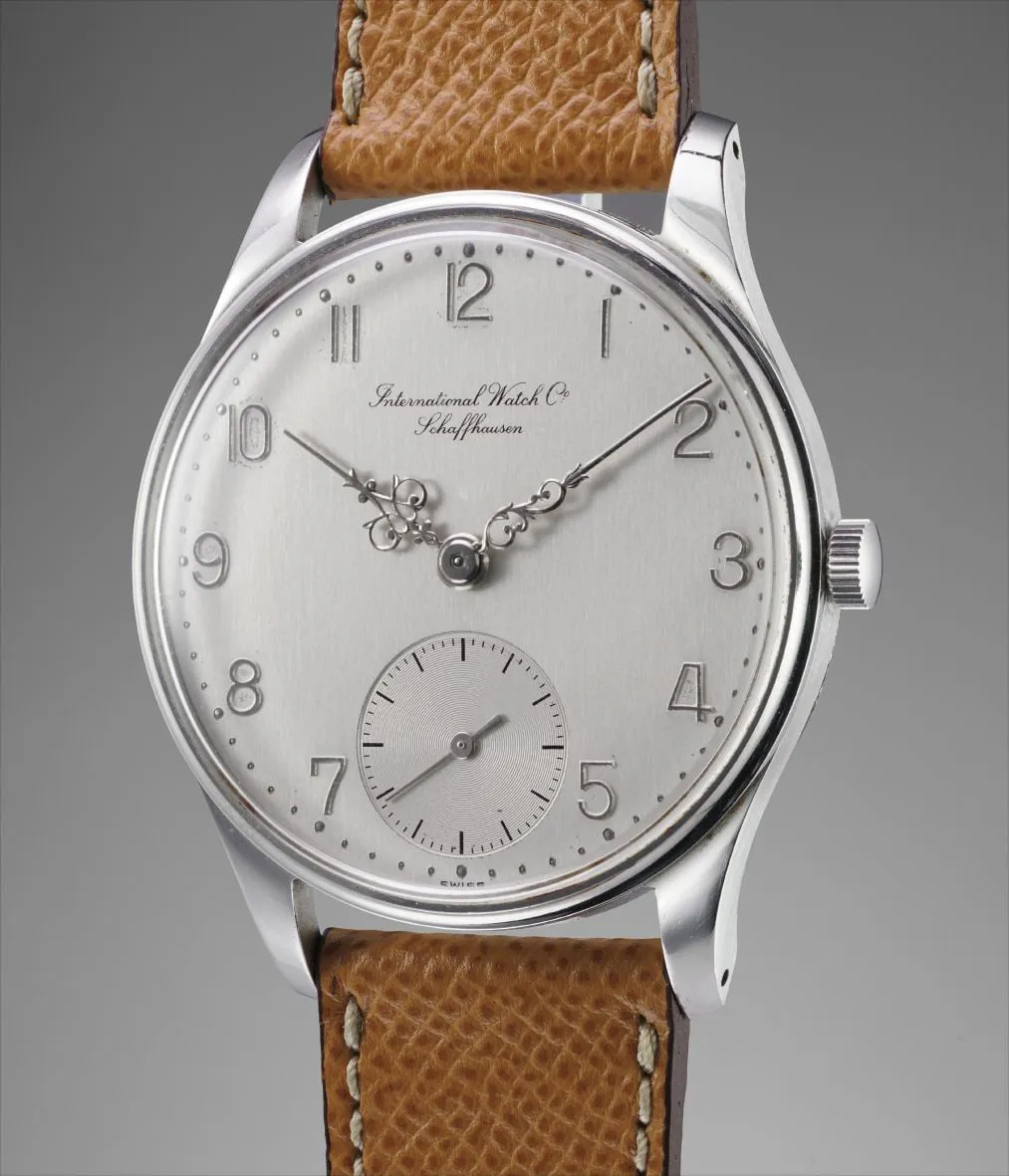
An early IWC Portugieser Ref. 325 in stainless steel – a groundbreaking 41.5 mm wristwatch housing a pocket watch movement. In the late 1930s, International Watch Co. (IWC) of Schaffhausen was approached by two Portuguese wholesalers, Rodrigues and António Teixeira, with an ambitious request: create a men’s wristwatch with the accuracy of a marine chronometer. At the time, men’s wristwatches were typically 30–35 mm in diameter, so IWC’s solution was radical – they encased a high-precision pocket watch movement in an oversized wristwatch case. The result would later be known as the IWC Portugieser Reference 325, though initially it had no official name or reference. IWC recorded it under the case model number “Mod. 228,” and only later adopted Ref. 325 to avoid confusion.

The first examples of this new large wristwatch were completed in 1939, but interestingly, they were not delivered to Portugal at first. Archive records show the very first delivery was on February 22, 1939 to L. Schwarcz, a wholesaler in Odessa, Ukraine. A few months later, additional pieces were sent to Lviv (then Poland, now Ukraine). It was only in 1942 that the Portugieser finally reached its namesake country: IWC shipped watches on February 2 and June 17, 1942 to Lisbon retailers (Pacheco, and Rodrigues & Gonçalves). These early sales occurred under the shadow of World War II, which likely delayed shipments – neutral Switzerland’s trade links were disrupted, and getting goods into wartime Portugal was challenging. Indeed, during the war years most Ref. 325 watches were actually sold in Eastern Europe (notably through two dealers in Bratislava), with relatively few reaching Iberia until peacetime. This helps explain why the model was never heavily promoted or included in IWC’s catalogs; demand was low and sporadic given the oversize 41.5 mm case was far ahead of its time.
By 1945, IWC’s ledgers recorded only around 250 sales of Ref. 325. The large size (dubbed a “giant” watch then) limited its appeal in an era of small dress watches. Even after the war, production of Reference 325 remained very limited. It appears IWC ordered more cases in the 1950s, but many of those orders were canceled and the unused cases sat in storage for decades. The Portugieser was, for many years, a sleeper in IWC’s lineup – virtually an open secret among a few enthusiasts rather than a commercial success. In total, only 690 examples of Reference 325 were produced between 1939 and 1981, making it one of the rarest and most sought-after 20th-century IWC watches.
Design and Case Construction
From the outset, the Ref. 325’s design was a blend of classic pocket-watch simplicity and modernist functionality. All original examples used the same case design (IWC case model 228) with a diameter of 41.5 mm and thickness of ~9.5 mm – extraordinarily large for its era. The case was a three-piece construction: a grooved bezel (designed to secure the less-fragile acrylic crystal of the time), a middle case body with integrated lugs, and a snap-on solid caseback. The oversized crown was deliberately chosen to make winding easy, another nod to its pocket-watch heritage.
Notably, every Reference 325 was cased in stainless steel. IWC used “Staybrite” steel, a high-grade stainless alloy prized for its corrosion and scratch resistance. The finish was utilitarian yet elegant: the mid-case had a brushed satin finish, while the bezel and lugs were polished, giving a subtle two-tone effect. IWC did not produce Ref. 325 in gold or other precious metals – all original Portugieser 325s are in steel, a fact that remained true until much later commemorative models introduced gold cases. The steel cases were manufactured for IWC by Wyss & Cie of Biel, a respected casemaker. Each case bore a serial number in the low seven-digit range (around 1,0XX,XXX) – any example with a significantly different case number falls outside known genuine ranges.
The dial of the Portugieser Ref. 325 exemplified clarity and restraint. There was no single “standard” dial – IWC actually fitted a wide variety of dial designs over the years. Known variations (about 18 in total across all series) include: clean silvered dials with simple Arabic numerals in a Bauhaus style, black dials with Arabic or even Roman numerals, a few Art Deco-inspired sector dials, and even some with ornate Breguet-style numerals or minute tracks. All versions featured a recessed small seconds subdial at 6 o’clock (since the pocket-movement’s seconds pinion sat at 6). The hour numerals were usually painted (enamel print) in Arabic script, but some early ones had applied metal indices or even radium luminescent numerals for navigation purposes. The overall aesthetic was “form follows function” – an understated, highly legible layout that took inspiration from IWC’s late-1930s pocket watches. Paired with thin leaf-shaped feuille hands (the most common hand style), the dial was a model of elegance. However, IWC did experiment with hand designs too: some references have syringe-style hands, and intriguingly, a portion of the last series were fitted with extravagant Baroque Louis XV hands – perhaps as a stylistic flourish in the 1970s. Regardless of dial or hand variation, every Ref. 325 remains immediately recognizable as a Portugieser: an oversized, uncluttered dial with vintage International Watch Co. script and a small seconds register.
The Three Series of Reference 325 and Their Movements
Although all Ref. 325 models look similar externally, collectors classify them into three distinct series based on the movements inside and time periods of production. IWC themselves eventually confirmed this by archival research, correlating movement caliber with production batches. Below is an overview of these series:
First Series (1939–1951) – Equipped with Caliber 74, 17 lignes, manual wind. Approx. 304 pieces produced.
Second Series (1944–1970) – Equipped with Caliber 98, 17 lignes, manual wind. Approx. 329 pieces produced.
Third Series (1977–1981) – Equipped with Caliber 982, 17 lignes, manual wind. 57 pieces produced.
Each of these IWC calibers was a high-grade pocket watch movement adapted for wristwatch use – all are 17‴ (ligne) size, roughly 38 mm in diameter, which accounts for the Portugieser’s oversized case. All three calibers beat at a traditional 18,000 vph (2.5 Hz) frequency and feature small seconds at 6 o’clock. Yet there are important differences in vintage and construction:
First Series: Calibre 74 (1939–1951)
The first batch of Portugieser watches were powered by IWC Calibre 74, a slim 17‴ hand-wound movement originally introduced in 1913 for hunter-case pocket watches. Cal. 74 is distinguished by its finger-bridge architecture (multiple arched bridges for the wheel train, rather than a 3/4 plate) and was lauded for its reliability and accuracy. In the Portugieser, Cal. 74 fit perfectly, requiring no modification to the dial or hands thanks to the movement’s orientation (crown at 3, seconds at 6). Technically, Calibre 74 measures about 38 mm across and 4.2 mm thick. It uses 16 jewels, has a Breguet overcoil hairspring, and a bi-metallic compensating balance with screws for regulation. Power reserve is around 30 hours – modest by modern standards, but typical for pocket watches of its era. One notable IWC innovation in Cal. 74 is the use of large-diameter bearings for the crown and ratchet wheels to improve winding smoothness. Finishing on early Cal. 74s was relatively utilitarian (brushed plates) compared to later calibers, but the movement’s build quality and precision were exemplary for the time. Approximately 304 first-series Portugiesers were made from 1939 to 1951 with Cal. 74 inside. These first-series pieces established the Portugieser legend, even if in their own time they remained an oddity.

Detail of a third-series Ref. 325 showing the Portuguese import hallmark (punção) on the lug. Only a minority of Reference 325 watches ever actually went to Portugal – IWC archives indicate 141 out of 690 were delivered there. These can be identified by a small stamped hallmark, or punção, applied by Portuguese customs. It appears as a tiny armillary sphere (often mistaken for an armadillo figure) punched usually on the upper left lug (though occasionally mis-stamped on a different lug). This quirky detail has become an important trait for collectors: a Portugieser with a punção mark definitively passed through Portugal’s assay office and paid import duties. The presence or absence of the hallmark does not affect the watch’s core characteristics, but it adds historical flavor – for example, one luminescent dial first-series watch with the punção (imported to Portugal likely for a client needing night legibility) was sold at auction in 2018 for $68,750. This underscores how sought-after these early Portugiesers have become.
Second Series: Calibre 98 (1944–1970)
Even as the first series was underway, IWC began to utilize an updated movement, Calibre 98, in the Portugieser. Cal. 98 was produced from 1936–1946, essentially a successor to the 74. Mechanically it shares the same layout and dimensions (37.8 mm × 4.4 mm) and likewise lacks shock protection. On paper, a Cal. 98 Portugieser is almost indistinguishable from a Cal. 74 version – indeed, externally IWC changed nothing about the case or dial when switching to Cal. 98. However, Calibre 98 introduced finer finishing and materials. The plates and bridges were nickel-plated and adorned with circular graining and Geneva stripes, a step up from the plain brushed finish of most Cal. 74s. This reflects IWC’s improving standards in the late 1930s and 1940s. Functionally, Cal. 98 maintained the 18,000 vph rate and similar 30-36 hour power reserve, but its slightly thicker height (about 0.2 mm more) was still easily accommodated in the same case. Between 1944 and 1970, IWC produced about 329 pieces of Ref. 325 with Calibre 98, making this second series the largest batch. Many second-series watches were assembled and sold after WWII (into the 1950s and 60s) using remaining Cal. 98 movements and the stockpile of cases. In fact, some Cal. 98 movements sat unused for years and were only cased up in the late 1960s when IWC “rediscovered” the leftover parts. This explains why the production span extends to 1970 even though Cal. 98 was made in the 1940s. Visually, second-series Portugiesers encompass the same dial variants as the first. If anything, IWC experimented more in the 1950s–60s with different dials (including some Roman numeral dials and colored accents) to make these large watches appealing in a changing market. Still, sales were very limited, and by 1970 the Reference 325 once again faded out – temporarily, as it turned out.
Third Series: Calibre 982 “German Edition” (1977–1981)
The final chapter of the original Portugieser saga came in the late 1970s. IWC’s vintage stock of cases had one last hurrah thanks to renewed interest from a Swiss dealer, Mr. Gilbert Golay, who in 1973 inquired about the big wristwatch from Schaffhausen. IWC agreed to produce a new batch, this time using its then-current Calibre 982 movement, an evolved version of the pocket-watch caliber made in the late 1960s. Plans were halted due to the quartz crisis chaos in 1975, but a few years later IWC quietly went ahead and assembled a small run of Ref. 325s with Cal. 982. In 1977–1978 they finished the watches, and by 1979 these began selling, predominantly to dealers in Germany (notably in Frankfurt) – hence the nicknames “German Edition” or “Missing Link” for this third series. Only 57 pieces of the third series were made, making it the rarest of the three batches.

Calibre 982 brought some modern upgrades while preserving the lineage. Introduced in 1967, Cal. 982 was IWC’s enhanced pocket watch movement with the same 37.8 mm diameter, but now featuring a shock absorption system (Incabloc), a monometallic Glucydur balance beating at 18,000 vph, and a fine adjustment via a swan-neck regulator. The balance staff had a simpler regulator than the older index, and IWC added small balance weights for precision timing. These technical improvements made Cal. 982 a more robust and accurate movement, better suited for the 1970s when expectations for daily-wear wristwatches were higher. The third-series Portugieser looks like its predecessors at a glance, but some received unique dial and hand treatments. IWC used Louis XV-style hands on many of these, a decorative flourish quite distinct from the earlier utilitarian hands. The dials too saw new variations – some third-series pieces have elaborate scripts or markers that mirror 1970s design sensibilities, yet all still exude a classic charm. Collectors dubbed this edition the “Missing Link” because it bridges the mid-century originals and the modern revival of the Portugieser line. In essence, these 57 watches (sold circa 1979–1981) were the last Ref. 325 Portugiesers ever made by IWC – and their subtle design tweaks directly inspired the revival model that was to come in the 1990s.
1993 Jubilee Rebirth and Legacy
By the 1980s, mechanical watches were resurging in appeal, and IWC’s leadership recognized the historical importance of the Portugieser Reference 325. In 1993 – IWC’s 125th anniversary – the company paid homage to the legendary model with the release of the Portugieser Jubilee Limited Edition (Ref. 5441). This commemorative watch closely echoed the design of the original: a large round case (42 mm), a clean dial with Arabic numerals and small seconds, and even the vintage International Watch Co. Schaffhausen script logo. Inside, IWC used Calibre 9828 (a refined variant of the 982 movement) visible under a sapphire display back – a nod to modern preferences. The Jubilee Portugieser was offered in three metals for the first time: stainless steel, rose gold, and platinum. Production was limited to 1,750 pieces total: 1,000 in steel, 500 in rose gold, and 250 in platinum. Each watch was individually numbered, and IWC even sold 125 special boxed sets containing one of each metal. An additional 50-piece variant for the Italian retailer Pisa featured blue Breguet-style numerals on a white dial – a unique touch differentiating it from the standard edition. The Jubilee series (Refs. 5441-01 to -07) marked the first time the Portugieser appeared in precious metal cases, ending the all-steel tradition of the original 325. The collection was a commercial and critical success; despite the sizable edition, it sold out quickly and sparked fresh interest in the “Portuguese” line among collectors.
The successful Jubilee reissue cemented the legacy of the Reference 325. What began as a niche project for a few Portuguese clients evolved, over half a century later, into one of IWC’s flagship collections. Following 1993, IWC expanded the Portugieser line with complications like a Minute Repeater in 1995 and chronographs in the late 1990s, all drawing design inspiration from the original oversized, open-dial concept. Modern IWC Portugieser models – from perpetual calendars to simple automatics – owe a debt to the trail blazed by Reference 325.
Collectability and Notable Examples
Today, the IWC Portugieser Ref. 325 enjoys an almost mythical status among vintage watch aficionados. With only 690 made, finding an original in excellent condition is exceedingly difficult. The watch was never widely famous in its own time (no known celebrities or heads of state wore one in the mid-20th century), but its extreme rarity and historical significance have made it highly coveted in retrospect. Prominent auction houses like Phillips, Christie’s, and Sotheby’s have handled a handful of Ref. 325s in recent years, often achieving strong results. For instance, a first-series Portugieser with black gilt dial, syringe hands, and Portuguese import stamp (circa 1942) fetched about $68,750 at a New York auction in 2018. Another early example delivered to Lisbon in 1942 was offered in Geneva the same year, highlighting the surge in interest for these once-obscure models. While these prices are high, they reflect the watch’s status as an iconic collectible piece of IWC history.
Beyond auction prices, certain Ref. 325s carry historical narratives. The very first piece sold (February 1939 to Odessa) and the first to Lisbon (1942) are documented in IWC archives and articles, and one can imagine the journeys those watches took through wartime Europe. A few pieces reside in the IWC Museum in Schaffhausen and are occasionally displayed to illustrate the birth of the Portugieser line. Seasoned IWC collectors often refer to the Ref. 325 as the “Holy Grail” of vintage IWCs – not for any complications (it’s a simple time-only watch), but because of its pioneering design and scarcity. Michael Friedberg, an IWC historian, noted that spotting a genuine Portugieser 325 is difficult and caution is needed, as forged “marriage” watches (with transplanted movements or incorrect cases) have appeared – one telltale sign of a genuine case is the 7-digit serial as mentioned earlier. This kind of forensic detail only adds to the intrigue for collectors.
In summary, the IWC Portugieser Reference 325 stands as a landmark in watchmaking: it was decades ahead of its time in size and concept, remained almost unnoticed for years, yet eventually became the foundation of one of IWC’s most beloved collections. Its story – from the foresight of two Portuguese clients, through wartime adversity and dormancy, to its triumphant revival – is a testament to enduring design and craftsmanship. For those lucky enough to encounter or own a Ref. 325, it is more than just a watch on the wrist; it is a piece of horological history with a story that spans over 80 years.
Sources
• IWC’s documented history of Reference 325 – History of IWC’s Portugieser Watches Reference 325 (IWC official forum) IWC: History of Reference 325 on IWC Forum
• Detailed early history and first deliveries of Ref. 325 – History of IWC’s Portugieser Watches Reference 325 (IWC official forum/ch-en) IWC: Ref. 325 history including first deliveries (EN)
• Production details and case/movement overview – IW325 models and production details (Watchbase) Watchbase: IWC IW325 overview and variants
• Technical background of steel case construction and size context – Phillips article on the IWC Portugieser Phillips: The IWC Portugieser story (Ref. 325)
• Archive-based production numbers and case details – Complete History of the IWC Portugieser Collection (Monochrome Watches) Monochrome: IWC Portugieser Reference 325 history and build details
• Auction records and examples – Christie’s Rare Watches sale listing Christie’s: IWC Ref. 325 lot (1943)
